RGB: Probably the best-known system is based on the RGB color space. This also makes sense from the physiological side of our eye, because we perceive colors through three different cone types in the eye: S cones (S = Short) are sensitive to shorter wavelengths between 400-500 nanometers, so roughly in the blue range. M cones (M = Medium) cover the medium wavelength range, i.e. between 450-630 nanometers with its absorption maximum in the green range. And finally, L cones (L = Long) allow us to perceive light in the wavelength range between 500-700 nanometers, covering the red range. We therefore see in RGB, in that the respective wavelength components are mixed additively by the brain to form the color that we ultimately „see“.
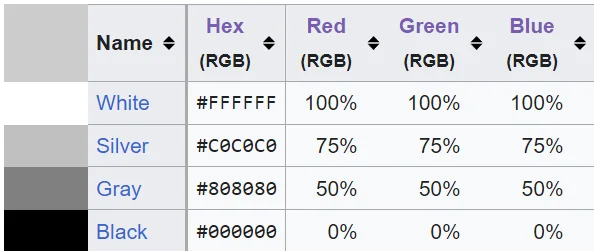
The “technical” RGB color space basically works the same way. As long as a maximum color Intensity is defined for R, G and B, almost any color can be defined through a mix of R, G and B-Values (between 0-1, 0-100% or 0-255). Just think of technical specifications for monitors, where it is a quality feature, especially in the professional field, how much and how accurately the panel covers the sRGB color space. RGB is also used in many image file formats, such as 8bit-TIFF, etc.
HEX: The abbreviation stands for „hexadecimal color definition“ and is an advanced method of color representation derived from RGB. A HEX code is based on the combination of six alphanumeric characters. Each character can represent a value between 0 and F, where 0 stands for no intensity and F for maximum intensity. The first two characters indicate the red component, the next two the green component, and the last two the blue component of the color, i.e. #RRGGBB. For example, the hexadecimal notation #FF0000 represents the color red, since the red component is maximum and the green and blue components are zero. HEX codes are especially common in web and graphic design, mainly because they are easier to copy than, for example, an RGB color code.
RAL: The RAL system, on the other hand, differs fundamentally from RGB and HEX and is especially widespread in the classic industry. Probably also because it is so simple: Each RAL color code is a four-digit number that represents a specifically defined color. The system comprises a little over 2,300 colors, each of which has a uniquely assigned number you can find in a color atlas. Because these definitions are based on physical measurements, the colors are always consistent and accurate, regardless of manufacturer or location.